;
;
Introduction to the Power of Narrative and the Magic of Storytelling
To understand the value of storytelling, we only need to look at one of the most famous dialogues in television history in the series finale of "Game of Thrones"; where Tyrion Lannister argues that nothing in the world can unite people as much as a "good story"; neither armies, nor gold, nor flags. This fundamental power has been evolving from the time Ernest Hemingway evoked the emotions of millions with a six-word story ("For sale: baby shoes, never worn"), up to the present day where brands and filmmakers utilize the most complex visual techniques.
From the perspective of psychology and cognitive science, storytelling is a powerful tool for penetrating the viewer's mind. Scientific studies and research show that a structured and engaging narrative triggers the release of the hormone oxytocin in the audience's brain; a hormone that awakens a sense of empathy and significantly reduces mental resistance and critical thinking. In the art of filmmaking and video production, narrative is not summarized merely in words, but flows through all visual and auditory elements, including lighting, color, camera movement, and editing techniques. Successful storytelling in video goes beyond simply sharing information; this process creates a bridge between the creator and the viewer, and forges a meaningful identity for the message.
Types of Narrative and the Fundamental Elements of a Story
To master the art of narrative within the frame of an image, it is essential to understand the building blocks of a story. Narrative writing encompasses a broad spectrum, which in video production is divided into five main categories: personal narrative (lived experiences often seen in documentaries), fictional and imaginative narrative (the creation of novel characters and worlds), non-fiction narrative, and finally, commercial and branding narratives. Each of these forms requires a deep understanding of the basic elements of a story, which are present in all formats, from literary novels to documentary films and short promotional videos.
The following table structurally explains the seven elements of a story and their function in video production:
| Story Element | Conceptual Definition | Cinematic Function and Execution in Video |
|---|---|---|
| Plot | The sequence of events driven by cause-and-effect relationships. | Determines the structure of the video, including the order of scenes, turning points, rising action, climax, and resolution. |
| Character | The individual or entity around whom the narrative revolves. | Creates an emotional connection point for the viewer. Characters must have a goal, obstacles, and a story arc. |
| Conflict | The clash of forces preventing the character from reaching their goal. | It is the driving engine of the story. Conflict can be internal or external, and in video, it is showcased through visual juxtaposition or dialogue. |
| Theme | The central idea, message, or hidden meaning in the underlying layers of the story. | Gives cohesion and purpose to the video. The theme is reinforced through visual symbolism, repetition of motifs, and color choices. |
| Setting | The time, place, and social/cultural atmosphere in which the story takes place. | Atmosphere creation is formed through location scouting, set design, lighting, and color grading. |
| Point of View (POV) | The position and perspective from which the story is narrated. | The camera acts as the viewer's eye and can provide a first-person or third-person (limited or omniscient) perspective. |
| Tone | The overall feeling and atmosphere the narrative creates in the audience. | Conveyed to the viewer through framing, soundtrack, pacing of the edit, and lighting style. |
Visual Storytelling: The Psychology of the Image and Cinematography
Visual storytelling is the art of conveying a narrative, idea, or complex emotion through images, in a way that minimizes the need for dialogue or textual explanations. In cinema and video production, the golden rule of "show, don't tell" reigns supreme. Cognitive psychology and the "Dual Coding Theory" proposed by Allan Paivio demonstrate that the human brain processes visual information with greater speed and depth than text, and mirror neurons are responsible for creating instant empathy with images that display human emotions. In this method, concepts such as space (the physical landscape in front of the camera), line (the movement path of objects that conveys intensity and emotion), shape, and color serve as the words of the visual language.
Directing and Camera Movements as Tools for Expressing Emotions
Every decision regarding the lens, angle, and movement of the camera transmits specific psychological information to the audience's subconscious. Spike Lee, the prominent cinema director, considers the camera angle to be the simplest method for demonstrating power dynamics among characters. Filming from a low angle gives the character a sense of dominance, power, and threat, whereas a high angle induces a sense of weakness, isolation, and vulnerability. He also uses Dutch angles to instill a sense of tension and imminent crisis, which disrupts the viewer's psychological balance. The use of one-take scenes to showcase organic dynamics between characters and breaking the fourth wall (where the character looks directly into the camera and speaks to the audience) are other techniques that eliminate the boundary between the viewer and the narrative.
The following table elucidates the psychological concepts hidden within key camera movements and shots:
| Cinematography Technique | Technical Description | Psychological and Narrative Impact |
|---|---|---|
| Push-in | The physical movement of the camera toward the face or subject. | Creates a sense of intimacy, emphasizes a crucial moment, or reveals a character's internal realization and discovery. |
| Dolly-Zoom | Moving the camera backward while simultaneously zooming forward (or vice versa). | Induces a feeling of vertigo, psychological isolation, distortion of reality, and displays sudden shock. |
| Tracking Shot | Moving the camera in sync with the subject through the environment. | Engages the audience in the subject's physical and psychological journey, maintaining the dynamism and rhythm of the scene. |
| Whip Pan | Extremely fast and blurred rotation of the camera on the horizontal axis. | An energetic transition between scenes or showing a quick connection and contrast between two subjects. |
| Extreme Close-up | A very tight framing, usually just on the eyes or an object. | Penetrates the deepest psychological layers of the character and creates claustrophobic tension. |
| Establishing Shot | A very wide shot at the beginning of a sequence. | Provides spatial and temporal context to the audience and establishes the atmosphere of the environment before the action begins. |
Advanced Narrative Techniques in Video Structure
Narrative techniques are methods employed by the filmmaker to control the flow of information, point of view, and time within a story. These techniques dictate what the audience knows, when they realize it, and how they interpret it. The correct selection of these techniques marks the difference between a simple report and a compelling drama.
One of the most powerful tools in this domain is playing with time and utilizing a non-linear structure. The use of flashbacks (returning to the past) and flash-forwards (jumping to the future) allows the filmmaker to inject vital information to the audience exactly at the moment it carries the most semantic weight. In literature, this is achieved by changing verb tenses, but in video production, flashbacks are showcased through editing cuts and changes in color grading. Another technique highly utilized in social media videos and commercials is "In medias res" (starting in the middle of things); where the story begins right at the peak of a crisis point without any preamble to hook the audience's attention in the very first seconds.
Additionally, employing an "Unreliable Narrator" creates a deep chasm between what the audience is told and what has actually happened in reality. In video, this technique is generated by creating a contradiction between the image (objective reality) and the narration (the character's subjective claim), providing an excellent foundation for building suspense. The use of red herrings to mislead the audience and the frame narrative (story within a story) technique are other methods that increase narrative complexity in a video.
Engineering Tone and Atmosphere in Cinema
Tone in cinema and video reflects the filmmaker's perspective on the subject and can manifest in comedic, dramatic, or suspenseful formats. Creating a tone requires perfect harmony among cinematography, set design, lighting, music, and editing. Examining the works of auteur directors demonstrates how the atmosphere of a video can be psychologically engineered: Christopher Nolan, in the movie Dunkirk, utilizes the auditory illusion of the "Shepard tone" to psychologically instill a sense of tension, anxiety, and an infinite ascent in the viewer. In contrast, Jordan Peele, in the film Get Out, purposefully uses warm lighting at the beginning of the movie to create a false sense of security, and with a gradual shift toward a dark and cold color palette as the story progresses, injects a tone of horror into the audience's subconscious. Wes Anderson, through obsessive symmetries in framing, bright and flat color palettes, and the use of slow motion, creates a comedic yet melancholic tone that serves as his personal signature. Furthermore, Quentin Tarantino is a master of employing contrast in tone; by playing upbeat and nostalgic music over highly violent scenes, he constructs suspense and a profoundly contradictory and unsettling atmosphere.
Storytelling in Documentaries and Realism
Storytelling is not solely limited to the realm of imagination. Ken Burns, one of the world's most successful documentary filmmakers, believes that still photographs are the DNA of visual storytelling. By applying cinematic techniques to historical still photos (using pan and zoom, known today as the Ken Burns effect), he imparts movement and life to seemingly inanimate images. Burns posits that editing and placing two images side-by-side (Juxtaposition) creates a third meaning that does not exist in either of the images alone (the 1+1=3 rule).
In poetic documentaries, where linear continuity gives way to atmosphere and the juxtaposition of images, the director of photography plays a pivotal role in capturing visuals that propel the story forward without the need for words. The use of live filming with lightweight equipment in real environments, as well as precise and psychological lighting in sit-down interviews (utilizing Key light and Backlight to highlight the subject and create soft shadows), greatly contributes to conveying a sense of authenticity and realism.
The Production Process: From Idea to the Screen
Crafting a story-driven video requires a structured and cohesive approach across three main phases. Carefully navigating these stages guarantees the narrative cohesion and visual quality of the work.
Pre-production
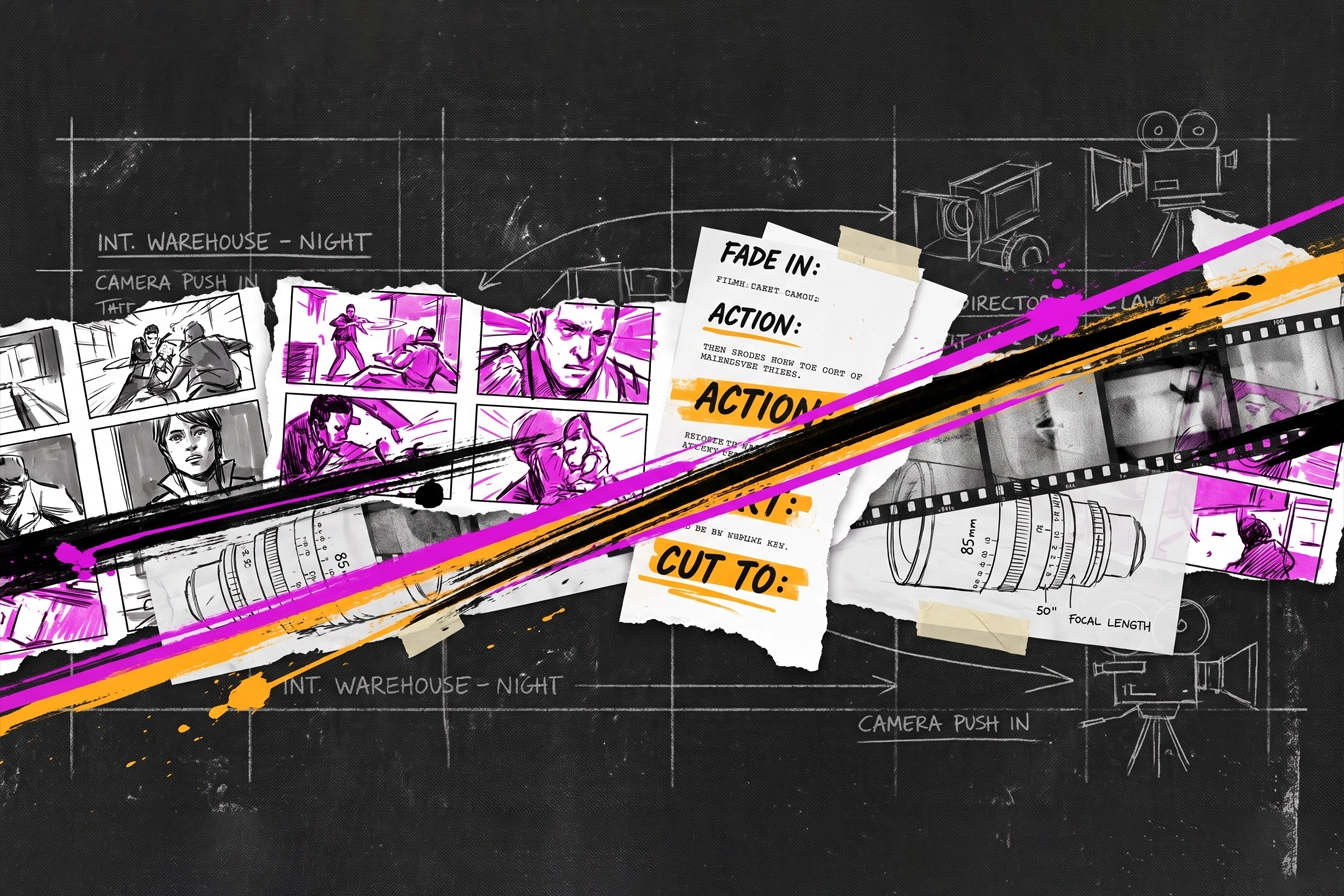
The bulk of a video's success is determined before the cameras even start rolling. This phase begins with brainstorming, analyzing the audience persona, and writing the script. The most important tool in this stage is storyboard design. A storyboard is a visual representation of the video's sequences that breaks down actions into consecutive illustrated panels. This tool allows the director to plan shot sizes, camera angles, composition, and the overall flow of action before arriving on set. Creating small illustrations (Thumbnails) of the script helps the production team spot potential issues and gain a shared understanding of the project's final vision. In this phase, using auxiliary software such as VideoScribe for previewing and creating animatics of ideas is also very common.
Production and Filming
The production stage is the time to execute visual strategies. In this phase, Mise-en-scène and Blocking gain special significance. Blocking refers to the arrangement of objects and the movement of actors within the frame. The distance between characters in a frame can reflect the state of their relationship or conflict without a single word being exchanged. Paying attention to continuity between scenes, maintaining records, and precisely directing actors to convey the story's correct tone are the responsibilities of the director and the director of photography.
Post-production
This stage, often known as the "final rewrite of the story," encompasses video editing, color correction and grading, adding visual effects, and sound design. Through selecting the best takes, removing redundancies, and using purposeful transitions (such as a Cross-dissolve for emotional moments or a fast Cut to imply speed), the editor discovers the story amidst the raw footage. At this stage, Sound Design, which includes mixing dialogues, sound effects, and the soundtrack, plays a key role in engaging the audience's emotions.
Storytelling in Video Marketing and Business Development
In the realms of advertising, social media, and digital marketing, storytelling is recognized as the most effective strategy for building trust, brand awareness, and increasing conversion rates. In commercial videos, instead of solely focusing on product features, the story should concentrate on human challenges, pain points, and emotional transformations.
A simple yet highly practical formula in designing promotional narratives is: "A story about X that is compelling because of Y"; where X is the subject of the story and Y is the emotional connection point with the audience. To structure this narrative, the AIDA marketing model is typically used, with its four steps implemented in a video as follows.
Attention: Capturing attention in the first 3 to 5 seconds, usually done with a strong Hook such as a shocking question or breaking a common cliché.
Interest: Introducing a challenge or need that the audience can empathize with and creating an emotional connection.
Desire: Introducing the product or solution as the tool the story's hero uses to conquer their challenge. The practical demonstration of benefits takes place in this section.
Action: A clear Call to Action (CTA) after the emotional knot of the story has been untied.
Today's audience is highly sensitive to overly commercial content. Authentic stories recounted by real users have a higher penetration rate. For example, Nike's famous "Dream Crazier" promotional video, instead of focusing on selling products, depicts the story of overcoming gender discrimination and the triumphs of female athletes, narrated by Serena Williams. This brand-driven approach significantly increases the audience's sense of closeness and loyalty. In addition to content, adapting the narrative format to the distribution platform is also crucial. Video length, pacing, and the expected type of engagement for publishing on LinkedIn or YouTube fundamentally differ from the consumption pattern on Instagram, and the final edit must be tailored according to the requirements of each platform.
Ultimately, mastering storytelling in video production necessitates creating a deep harmony between the art of writing and the technical sciences of cinematography, lighting, and editing. By leveraging classical story elements and understanding the psychological needs of the audience, filmmakers can transform information that normally seems dry and lifeless into tangible and inspiring experiences. The truth is that the mission of storytelling in video is to forge a connection that transforms the viewer from a passive observer into an active, emotional participant.