;
;
While traditional media like cinema and literature rely on one-way information transfer and classic three-act structures, video games require the integration of these structures with the flow of gameplay and strategic elements of the game. Storytelling in this modern context does not merely revolve around words or cinematic cutscenes; rather, it forms the core of the player experience design. Player interaction and agency are the tools through which game mechanics, level design, and artificial intelligence all act as narrative devices. Deep analysis of this field shows that successful storytelling is achieved when traditional writing and interactive system design are in perfect harmony, and the player, by entering the "Magic Circle," suspends their disbelief to accept and immerse themselves in this virtual world.
Fundamental Concepts: Narrative Design vs. Game Writing
In the video game development industry, the two concepts of "Game Writing" and "Narrative Design" are often considered synonymous, whereas there are deep functional and structural differences between them. A game writer focuses their efforts on creating words, dialogues, lore, and item texts. Their main task is to choose the highest quality and most expressive words to advance the plot and deepen characters, so that these texts are ultimately implemented into the game by the development team.
On the other hand, the narrative designer stands at the intersection of game design and storytelling. The main concern of a narrative designer is not what the story says, but how the story is conveyed to the player through interactive tools and how all game components serve to express it cohesively. For example, if the story's goal is to create a sense of anxiety in the player, the writer might write scary dialogues for the characters; however, the systems designer thinks about how the player engages with resource management, and the narrative designer thinks about how limiting inventory space can directly induce the feeling of anxiety and survival in the player. Here, inventory management is not just a mechanic; it is a narrative tool.
Human psychology plays a significant role in this approach. The Heider-Simmel animation experiment clearly showed that humans have an innate tendency to assign motivations, intentions, and personality traits even to geometric shapes with completely random movements. Understanding this innate story-making instinct in humans, narrative designers use the game's feature set and mechanics to tell the story so that there is minimal interruption in the flow of gameplay and the story's message is conveyed to the player subconsciously. This concept is tied to diegetic design; elements that are also visible and comprehensible to the in-game character (like a UI that is part of the hero's spacesuit or music playing from an in-game radio) increase player immersion and strengthen their bond with the virtual world.
Pillars of Player Experience: Context, Action, and Emotion
Video games are inherently "motivation engines" that operate on three main gears: Context, Action, and Emotion. Abigail Rindo, in her examination of narrative design fundamentals, points out that these three elements are essential for guiding the player through the game world and teaching them its systems.
Gameplay verbs and mechanics are considered the primary storytelling tools. The actions a character can perform—whether punching, shooting, hiding, jumping, or talking to others—directly indicate their identity, abilities, and status in the game world. Narrative design begins with this question: what kind of character engages in such behaviors, and how do these actions provide the player with deeper insight into them?
The answer to these questions lies in the "Feedback Loop." This three-step cycle includes: player action (pressing the attack button), its effect in the game (successful attack on the enemy), and feedback (displaying the enemy's damage animation). In principled narrative design, written words also act as a form of this feedback. Good writing in a game does not force itself upon the player without reason, but occurs in reaction to their actions. This is why game designers usually place long cinematic cutscenes after a tough battle with boss fights; this not only advances the story but also acts as a psychological reward and an opportunity to rest, which manages the flow of gameplay in a positive way.
Story Architecture: Embedded to Emergent Narratives
Media theorist Henry Jenkins has identified four main types of narrative architecture in video games, the understanding of which is essential for level designers and writers. The balance and combination of these approaches determine the extent of player freedom and how the plot is presented.
| Narrative Type | Operational Mechanism and Key Features | Examples and Applications |
|---|---|---|
| Embedded | Pre-determined, linear stories directed by the creators. Player emotions are carefully controlled, and their agency does not structurally impact the ending. | Story-driven action-adventure games. Maintains high emotional consistency and pacing control. |
| Emergent | A narrative that is not authored by the game system, but dynamically forms from the player's interactions with rules, random variables, and AI. | Simulation games (like The Sims) or sandboxes. Very high replay value, but lacks pre-engineered dramatic arcs. |
| Evocative | Relies on memories, preconceptions, and symbols the player recognizes from media or the real world. Uses familiar patterns to convey information quickly without dialogue. | Games adapted from movies or titles that use visual archetypes (like explosive red barrels). |
| Enacted | Stories defined by mechanical progression, leveling up, and the growth of character abilities in the role the player has assumed. | Role-playing games (RPGs) that focus on avatar development and enhancement. |
The primary conflict in the game development industry is between embedded and emergent narratives. Embedded narratives, like cinema, allow designers to engineer character arcs with great precision. However, emergent narratives turn the game into a platform resembling reality. In this case, events are dynamic and hypothetical, and the story only takes shape in the player's mind after events occur and a cause-and-effect relationship is established among them.
The main challenge in emergent narrative is preventing the creation of hollow stories; while procedurally generated systems can produce infinite events, it is the player who must filter unrelated incidents and create a meaningful thematic story around them. Combining these two approaches in the form of non-linear narratives—such as games with a main embedded story that allow the sequence of events and interactions to happen emergently—has become one of the most successful modern patterns.
Environmental Storytelling: Indexical Art and Discovering History
One of the transformative techniques for conveying narrative concepts is environmental storytelling. This concept, introduced by Don Carson based on Disney theme park design principles, refers to the purposeful arrangement of visual assets, architecture, and objects in the game space to imply a story without the direct use of words. While traditional tools like cutscenes present information directly and performatively, environmental storytelling showcases the final result of a series of events, forcing the player to act like a spatial detective to discover the process that led to this outcome.
"Indexical storytelling" is built upon traces left in the environment. Cause and effect vignettes are the most powerful manifestation of this approach. For example, finding a skeleton next to a bathtub full of empty bottles, or the burnt wreckage of a car that has smashed through a wall, requires no guiding text. The player's mind automatically fills in the blanks of the events. This active mental participation significantly increases the player's immersion and commitment to the game world. In Duke Nukem, the destructive impacts of the player's actions on the architecture and environment are themselves a narrative of chaos and the passage of time.
Furthermore, the environment can reflect psychological states. Architectural design utilizing Gestalt psychology, contrasts, and formal relationships can guide the player on a subconscious level. For instance, the narrative transition in Portal 2 from sterile, controlled laboratories to dark, cluttered maintenance areas directly reflects the story's shift from systematic captivity to survival and escape. Similarly, in Half-Life 2, claustrophobic corridors and an abundance of security cameras induce a sense of systematic oppression and constant surveillance much stronger than any dialogue could. Environmental storytelling reaches its peak when all environmental elements serve a single macro theme; for example, in Deus Ex, the presence of anti-augmentation graffiti in the environment, alongside scattered emails and slum designs, clearly conveys social inequality.
Challenges of Consistency: Ludonarrative and Ludomechanical Dissonance
Achieving unity between narrative and mechanics consistently faces a challenging phenomenon called "Ludonarrative Dissonance." Coined by Clint Hocking in 2007 during his analysis of BioShock, this term refers to the cognitive conflict and contradiction between the story the game tells through cutscenes and the narrative the player experiences through gameplay mechanics.
In critical reviews of this phenomenon, the Uncharted series is frequently cited as a reference. In the story and cutscenes, Nathan Drake is a witty, kind, and morally positive man, but during gameplay, the player massacres hundreds of mercenaries, turning him into a ruthless killing machine. This disconnect can shatter the player's suspension of disbelief. Narrative dissonance usually stems from designers prolonging combat loops to satisfy the audience's desire for continuous action, without considering its moral weight. Mafia 3 also exemplifies missed opportunities in this area; although the game's story revolves around racial discrimination in 1960s America, the development team removed mechanics like speed limits and police reactions to the black protagonist's driving to prevent player frustration, which consequently reduced the plausibility and the player's deeper empathy with his struggles.
Another related phenomenon is "Meta-Ludonarrative Dissonance," which addresses the difference between the player's feelings and the protagonist's feelings. In Portal 2, while the character Chell, as a semi-silent protagonist, intends to escape the deadly experiments and suffers through them, the player enjoys solving these engineering puzzles and wants the game to continue.
On the other hand, the conflict of mechanics with one another, disregarding the game's internal logic, leads to "Ludomechanical Dissonance." This occurs when the game asymmetrically changes its rules to the player's detriment to artificially increase difficulty. For instance, in Valkyria Chronicles, sandbags provide 360-degree protection for enemies when logically they should only cover one side, or in XCOM 2, enemies do not face the same time constraints as the player. Using artificial exceptions like these is essentially a patch to cover balance weaknesses in system design.
However, critics note that ludonarrative dissonance is not necessarily a design flaw. Some designers, like Walt Williams in Spec Ops: The Line, deliberately utilized this contrast to highlight the character's hypocrisy and psychologically pressure the player into questioning their violent actions within the game environment. Opposed to this concept is "Ludonarrative Consistency," where gameplay reflects the story. Using clunky controls to simulate drunkenness or the stressful bureaucracy of stamping papers in Papers, Please are excellent examples of harmony between form and content.
Interactive Design: Engineering Branching Conversations and Consequences
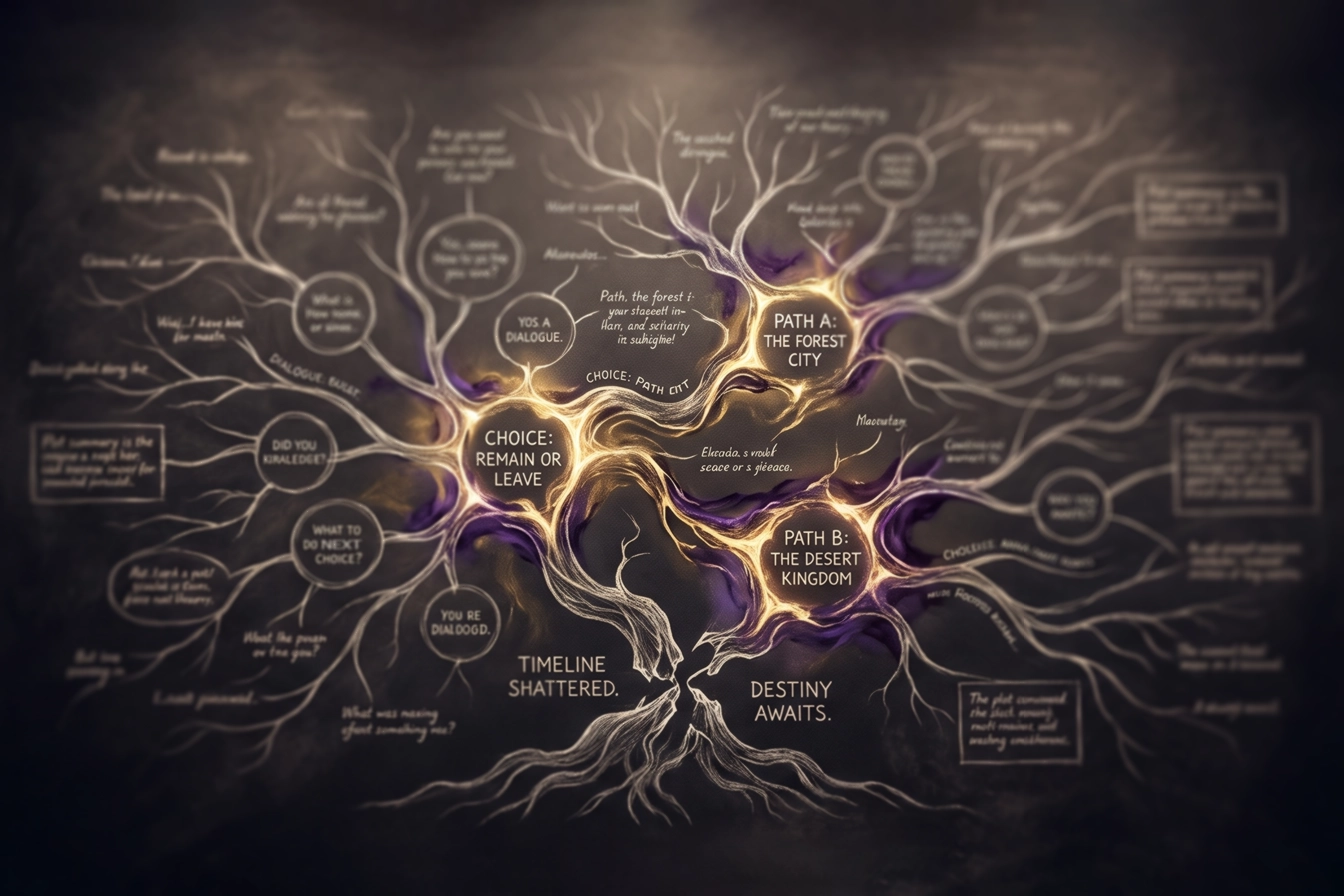
When designers attempt to incorporate player agency into verbal interactions, dialogue trees become one of the most critical and sensitive parts of design. The structure of a conversation tree consists of two essential components: question hubs and choices.
Question hubs are used to extract background details and expand the game world without causing irreversible changes to the storyline; the player can select these dialogues and then return to the central point of the conversation. However, determining choices irreversibly alter the story's path. Professional designers recommend that, to avoid player confusion, hub options should always be written with a question mark or inquisitive tone so the player knows selecting them won't trigger linear consequences.
Fundamental principles in writing branching conversations include:
- Providing information and consequence transparency: the player must have sufficient information before making a decision to weigh the potential consequences. Keeping the player blind reduces the value of the choice, reducing it to a lottery. At the same time, creating minor surprises in the outcome of a choice adds dynamism to the conversation.
- Dynamic responsiveness: non-playable characters (NPCs) must show meaningful reactions to the player's tone and decisions. Ignoring the player's responses and artificially returning to the linear flow of conversation severely suppresses the sense of agency.
- Managing exponential growth via loops: the mathematical challenge in branching dialogue is the exponential growth of variables. If a conversation has three branching points, each with three options, the designer must write 27 different paths; adding one more option increases this to 64 paths. To combat this crisis, designers use loops and returns, where seemingly different choices merge back into the main flow after a few lines of dialogue, while the system remembers the player's decision by recording variables and reacts to it in future events.
Development Tools and Team Synergy in Narrative Design
Implementing this level of complexity and managing narrative variables requires specialized tools and collaborative workflows. Narrative designers never work in isolation; their final achievement demands continuous coordination with level designers, the art team, AI programmers, and audio engineers. For example, a new branch in dialogue requires animators to know the character's reaction and environment designers to anticipate the necessary space for that event. In the ideation phases, digital whiteboards and collaborative tools are vital for drawing flowcharts, rapid prototyping, and organizing the knowledge base.
Narrative design software tools allow designers to manage dialogue trees and nested branches visually or via pseudo-code. Attempting to write a story-driven, non-linear game in a simple text file will lead to logical disasters, narrative dead ends, and severe bugs in variable tracking.
| Software/Tool Name | UI Nature and Core Functionality | Use Case and Target Audience | License and Compatible Engines |
|---|---|---|---|
| Twine | Node-based with a roadmap visual. Simple and visual. | Ideal for rapid prototyping, creating text-based interactive stories, and small indie projects. Managing massive projects is difficult. | Free (Open Source) / Web-based with HTML export |
| Ink | Based on an advanced scripting language. Lacks a complex visual editor. | For narrative designers with a programming mindset. Highly scalable and used in professional studios. | Free (MIT) / Integrates with Unity and custom engines |
| Yarn Spinner | Based on simple pseudo-code (inspired by Twine). | Great for games with more linear dialogue systems and controlled branches. Excellent synergy with the Unity ecosystem. | Free (MIT) / Unity, Godot |
| Arcweave | Node-based, cloud environment. | Allows teamwork and real-time collaboration, along with audio/visual content management and rapid prototyping. | Limited Free / Paid / Unreal, Unity, Godot |
| articy:draft | Massive, visual database (desktop software). | The standard for large teams (AAA). Advanced variable management, character databases, and massive game design documentation. | Commercial (Paid) / Unreal, Unity |
| StoryFlow Editor | Visual, node-based, no-code. | Real-time simulation, visual management of all variables, prevention of logical bugs, and direct export to game engines. | One-time purchase / Unreal, Unity, Godot |
The use of visual node-based systems like StoryFlow or Arcweave has the significant advantage that designers can debug logical paths and clearly map out conditional variables (such as checking a player's credit or reputation before presenting dialogue) before inputting data into the game engine. This workflow enables teams to focus on creating a compelling and cohesive narrative structure rather than getting bogged down in coding issues.
Conclusion
Video game developers today are at a point where traditional writing is not enough to create lasting experiences. Storytelling in this interactive medium is a process that requires precise engineering among three main pillars: form, content, and player agency. As examined, narrative designers—by using gameplay mechanics as communication tools, employing emergent approaches to grant freedom to the audience, and utilizing environmental storytelling to enrich the visual canvas of the game—create worlds where the player is not just a listener of the story, but emerges as a co-author.
Challenges like ludonarrative dissonance show us that the slightest conflict between the system's mechanical goals and the story's moral messages can shatter the foundation of immersion. On the other hand, managing branching dialogues and their structural complexities would be impossible without a correct understanding of the mathematics embedded in variables and the use of collaborative tools. Ultimately, the true art of storytelling in video game development is the subtle guidance of player agency within a multi-layered, engineered structure so that, in the end, a personalized, cohesive, and deeply impactful narrative takes shape in their mind.